


Redistricting plan keeps Big Horn Basin representation
It looks like the Big Horn Basin will be able to hold on to its nine seats in the Wyoming Legislature after the Joint Corporations, Elections and Political Subdivisions approved a redistricting plan during a meeting on Jan. 19 in Cheyenne.Rep. Elaine Harvey of Lovell, who has worked closely with other legislators from the Basin to craft new district boundaries, said in an interview last Thursday that the plan is the most workable for the Basin, even though concern was expressed in Meeteetse about being represented as part of a district that extends all the way south to Hot Springs and Fremont counties.A Wyoming Supreme Court decision many years ago requires the Wyoming Legislature to go through a redistricting process every 10 years following the census to meet the principle of “one person, one vote.” That is why legislative districts are no longer based on county lines, Harvey explained. The court ruling requires each legislator to represent a similar number of people, with a slight deviation allowed.The ideal number of people for a member of the House of Representatives to represent, based on a growing Wyoming population, has grown over the years, Harvey said, and the ideal now stands at 9,394, with an allowed deviation of plus or minus 5 percent.Population shifts in the Big Horn Basin have required district lines to be redrawn, and last fall the nine Basin legislators -- three senators and six representatives -- met to formulate a plan that would redistribute the population in the House districts within the allowable deviation.To keep the nine legislators in the Basin, the legislators realized that one of the districts would have to expand into another county, and the nine decided to expand House District 28, a seat in the House currently held by Rep. Lorraine Quarberg of Thermopolis, into Fremont County – Lysite and Shoshoni – as well as expand north into Park County.[caption id="attachment_2777" align="alignright" width="366" caption="This map, courtesy of the Wyoming Legislative Service Office, http://legisweb.state.wy.us/lsoweb/, shows new district boundaries."]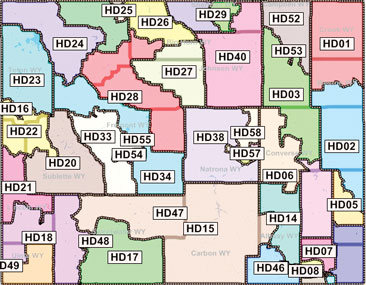 [/caption]District 28 would now cover portions of four counties: all of Hot Springs, southwest Big Horn, southeast Park and northern Fremont, wrapping around Washakie County.The plan pleases Harvey, because she would get to retain Deaver and Frannie in House District 26 and gain the rural area to the west of the communities, noting that the legislature established guidelines for redistricting to consider “communities of interest” in the planning process.Willwood, currently split between HD 26 and HD 50, would be unified under the plan into HD 50, and HD 26 would gain the rural area east of Garland, though the town of Garland and the rural area west of the community would be in HD 25 with Powell.Meeteetse issuesAll comments during an Oct. 4 public meeting in Deaver were positive in regard to the plan, but concerns arose from the Meeteetse area, which is currently a part of HD 24, represented by Rep. Sam Krone of Cody, but under the plan would become part of HD 28, represented by Rep. Quarberg of Thermopolis.The original plan drawn up last fall actually split the three Meeteetse area voting districts, Harvey said, with one going to HD 24 and two becoming part of HD 28.While there was little attendance at an Oct. 5 public meeting in Meeteetse, the Park County Republican Women believed there had not been enough vetting of the issue and scheduled three more public hearings in Powell Cody and Meeteetse. It was during the second meeting in Meeteetse that residents of that area expressed their concern in no uncertain terms, Harvey said.“I was not in attendance at that second Meeteetse meeting, but I guess things got pretty hot,” Harvey said. “Sen. (Gerald) Geis would be their new senator (two House district nested in each Senate district), and they wanted (Hank) Coe (of Cody). They wanted their representation to stay in Park County.“They said their community of interest belonged in Park County, their newspaper (the Cody Enterprise) was in Park County, and they shop in Park County. They felt they should remain with a Park County district because of that principle, community of interest.”Hearing the concerns of Meeteetse, the legislators got together again on January 5, Harvey said, and decided to stick with the original plan, with some slight modifications, fearing that if they gave ground on the Meeteetse issue, the Basin could lose House District 28 to Fremont County.“We felt like the area of interest for the Big Horn Basin was more important than keeping Meeteetse in Park County,” Harvey said.One concession was made to place all three voting districts in HD 28, rather than splitting them, and thus the area school district, cemetery district, conservation district and the like would be together in HD 28.Coe, Krone, Childers and Harvey held a meeting in Meeteetse on Jan. 12 attended by some 30 people to explain the decision, and Harvey called the tone of the meeting “pretty reserved.”Harvey said she explained to the residents that, just because the legislative districts are organized a certain way doesn’t mean that local legislators won’t continue to work hard for area residents. For instance, she will continue to advocate for Willwood residents, even though a part of the Willwood area formerly in District 26 is now in District 50.“I’m now one more voice for their school district and their hospital district,” she said.Big Horn County has been split up for years, she said, and told the Meeteetse residents that former Sen. Carroll Miller of tiny Shell represented and successfully campaigned in much larger Powell, many miles away.“I tried to assure them that being represented in Hot Springs County would not disenfranchise them but would actually empower them because they would have one more person interested in them and their issues,” Harvey said. She said concerning newspaper coverage that residents should work with the Thermopolis paper (the Independent Record) to step up coverage of the Meeteetse area and build circulation in the area.The plan brings Harvey’s district to a deviation of minus-4.79 percent, she said, which is acceptable.Approved by the Corporations Committee on Jan. 19, the statewide redistricting plan will now go before the full legislature during the 2012 budget session, which begins on Feb. 13.By David Peck
E-Edition
307-548-2217 | 234 E. Main St. Lovell, Wy 82431
