HOUSING CHALLENGES

By: 
Avery Howe

Bright Block Initiative takes aim at SHBC’s housing crisis


Lack of housing availability is at the forefront of economic concerns in south Big Horn County. A new nonprofit, Bright Block Initiative, hopes to turn that around. 

“I feel positive about it,” Danae Bales, president of the nonprofit board, said. 

Bright Block is a grassroots nonprofit spearheaded by locals concerned with the state of economic development in south Big Horn County. After completing the Wyoming Business Council’s Assessment to Action (A2A) survey in September, the group decided to take citizens’ concerns, collected over a wide demographic, and turn them into progress. After talking to 70 citizens, one theme stuck out: people remain hopeful. 

Bales, Bill Hayes, Serena Lipp, Gerald Crist and Michael Johnston formed the board of directors for the 501 (c) (3) Bright Block Initiative, which will look to improve local properties, encourage development, and make housing more attainable in south Big Horn County.  

Housing costs have risen faster than income across the United States since 2000, exacerbated by the Covid-19 pandemic with house prices jumping by 23.8%, the fastest rate on record, from December 2019 to November 2021 according to the National Bureau of Economic Research. The Wyoming Cost of Living Index shows that from 2024 to 2025 in Big Horn County, the average rental cost increased across the board: up 8% for an apartment, 13.3% for a house and 7.3% for a mobile home. Wyoming’s total personal income only increased by 4.4% in the same timeframe.

“After going through this (survey) process, it was really life changing. And it shifted the way that we looked at what was going on in our communities,” Bales addressed the Greybull Town Council on Monday. 

The A2A survey showed that housing availability has had a perceived effect on businesses, schools and individual wellbeing among citizens who have struggled in the past five years; finding rentals and starter homes in the area unattainable. “Really low availability of quality places” and “unless you build, your choices are limited,” were common sentiments among those surveyed. 

With many houses in the south Big Horn Basin built in the 1970s or before, typically on small lots, the survey found that most available housing would require considerable repairs and remediation to be livable, with low-end purchase prices still starting around $150,000.

Additional concerns included contractors being unwilling to build in a shrinking population base and local banks declining to administer loans on older houses in poor condition or participate in first-time homebuyer programs. Failing infrastructure also reduced confidence in investing in homeownership. 

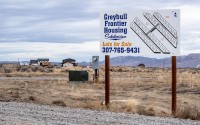
In Greybull, new housing is relatively stagnant, with town records showing 17 residential building permits issued in the past five years, eight of which were granted in the Frontier subdivision, land previously owned by the Town of Greybull. Of 37 lots, Greybull advertises eight still available for sale. 

Basin has seen even less development, with only 11 new homes permitted since 2020, while the Town of Burlington, estimated population 379, has seen comparatively impressive growth. In the past three years, they issued 17 new residential building permits, and their population is estimated to have grown almost 20% since 2020. Burlington’s schools have also seen stable to increased enrollment, especially in younger grades, while Greybull’s schools saw a drop for the fourth consecutive year. 

“School funding is based on how many students you have enrolled. 

So, if our families are leaving because they can’t afford to live here, that’s a problem,” Bales said on Monday. 

Burlington’s growth can be partially contributed to their 76-lot Husky Subdivision, which according to Town of Burlington Clerk/Treasurer Chelsey Aagard, only has one remaining lot for sale. The Town of Burlington purchased the subdivision property about two decades ago to answer a need for residential properties in an agricultural community. Their lot prices are posted at $8,000 per quarter acre. An A2A critique of the Frontier subdivision, for comparison, was that lot sizes were designed too large, with most parcels ranging from one to two acres at a minimum $3,000 per acre bid, which made inefficient use of available land. 

A game plan for Basin and Greybull will have to be different. Bright Block plans to focus their efforts on cleaning and clearing abandoned lots for infill, rehabilitating existing homes back towards safe use, building family and starter homes and adding sidewalks and trees for curb appeal. They will look to help an aging population maintain their current homes through organizing volunteer work, while increasing availability for young families by connecting developers to open lots. 

“We’re not a developer. We’re a nonprofit. We are here to help with marketing, here to help with gathering and connecting other entities, other groups, people, founders, donors, to be able to make it possible,” Bales addressed the Greybull Town Council. 

For starters, Bright Block will look to partner with Spirit Mountain Habitat for Humanity, which Bales reported recently received authorization to operate in Big Horn County. They will also look to apply for a $5,000,000 state infrastructure grant for counties, towns and municipalities. Near-term milestones will include publishing a candidates list for clean-up, launching the first bright block with clean-ups and rehabs, issuing a builder request for information on 4-8 starter homes, and advancing a pet-friendly rental pilot. 

“Housing unlocks almost everything,” Bales said in a release. “One bright block at a time, we’ll show that good things still happen here.”

For more information on Bright Block Initiative, visit brightblockinitiative.org. 

Category: