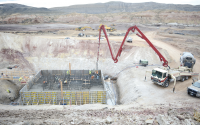
Steady progress at Leavitt’s site
Aggregate work ahead of schedule, construction of 90-foot tower begins
A Saturday was required to complete one of the biggest undertakings thus far in the expansion of the Leavitt Reservoir northwest of Shell.
Using nine of its mixing trucks, which it couldn’t have done on a weekday without shutting down one of its plants, Big Horn Redi-Mix spent most of the day delivering 29 loads of concrete to Leavitt’s, where Big Sky Civil Contractors and Montana Civil Contractors employees were forming the base of a 90-foot outlet works tower.
The order called for just over 280 cubic yards of concrete. Adding to the challenge was the approximately 20 miles that had to be covered between the Greybull plant and the reservoir, resulting in round trips of about two hours.
“We had a lot of trucks going, but everything went well,” said Big Horn Redi-Mix manager Jim O’Keefe, who added that several more pours are planned in the coming weeks as the building of the outlet works tower and the dam continues.
The goal of the project is to provide additional late-season irrigation water. The old reservoir covered 45 acres and impounded 643-acre-feet of water; the new one will cover 203 surface acres and impound 6,604 acre-feet. When it’s completed, water from Bear Creek will be diverted into a wetland area and then the reservoir itself, where it will be stored until it is released for late-summer irrigation.
The outlet works tower will play a key role, according to Kevin Mininger of RJH Consulting, the engineering firm that was hired by the Shell Valley Watershed Improvement District to oversee the project.
“For one thing, it will serve as a multi-level withdraw system,” said Mininger. “(The SVWID) will be able to pull from the reservoir at three different elevations — from the bottom, from a third of the way up and from two-thirds of the way up.
“What that will allow them to do is optimize the water quality. Obviously, the water at the bottom will be the coolest temperature, but it’s sometimes low in oxygen content. Certain requirements will have to be met when releasing water to improve the aquatic habitat in Beaver Creek downstream. Looking at the temperature and the dissolved oxygen, that gives them the flexibility to blend water from different elevations or pull from a single elevation, wherever it makes sense.”
The other purpose of the outlet works tower is to serve an emergency spillway. The tower will feature two cavities. On one side will be the gates that regulate the amount and location where the water is withdrawn. The other will be open. “That’s the spillway,” he said. “If the reservoir is full, there’s a precipitation event and water flows into the reservoir, it’ll drop into that tower and go out through the bottom to maintain the maximum pool of the reservoir without letting it fill too much.”
Don Scott, Montana Civil’s superintendent, said a 42-inch pipe at the bottom of the outlet works tower will be encased in concrete and stretch about 500 feet as part of this phase of the project.
Ahead of schedule
The first quarter of 2024 couldn’t have gone much better for SVWID and the contractors.
When bids for the four components of the project were opened late last year, the SVWID awarded three contracts that totaled $62.9 million. Big Sky Civil and Montana Civil landed the largest of the four, Contract A, to construct the dam, outlet works, wetland mitigation area and recreational facilities, with a bid of $36.4 million. The two companies also landed Contract D, to produce aggregate materials from the terrace borrow area, with a bid of $17.9 million.
Contract B, to construct the supply pipeline and associated structures, went to Mountain View Builders of Sheridan, which bid $14.6 million.
The SVWID did not award Contract C, however, to construct a transfer pipeline and associated structures. The low bid came in at $14.6 million, which was slightly outside the estimated range of $12 million to $14 million.
Upon the recommend-ation of the Wyoming Water Development Commission, the Wyoming Legislature resolved the issue during its recent budget session, earmarking $56.8 million for the Leavitt Reservoir project as part of Senate File 75 (Omnibus water bill - construction).
With that, the total project cost rose to $88.85 million. Of that, the state is paying $87.13 million. The remaining $1.72 million will be repaid by the SVWID over a 50-year period, at an interest rate of 4%.
On site, there were no complaints about the mild winter. “They were able to continue to get work done — especially in terms of aggregate production, which is several months ahead of schedule,” said Mininger. “They have produced 80% of the total amount of aggregate that will be needed. The majority of what’s left is the rip rap, which of course is the slowest going.”
In a typical day, there are approximately 30 people working on site, with most being employees of the contractors although a few locals have joined the crew, according to Mininger. The peak will probably come in June. “As they get more of the foundation of the embankment prepared, and have a little bigger work area, the contractors may increase their crew size,” he said.
The project is expected to require two years to complete, with most of the work expected done by the end of 2025. Some pipe work may stretch into the early part of 2026, but Mininger is confident the goal of filling the reservoir for the first time in the spring of 2026 will be met.